Table manners that still matter (and the ones that don’t)
Good table manners aren't about forks. They're about making everyone comfortable. The rules that still matter at dinner, and the ones you can forget.
Good table manners are not about knowing which fork to use. They are about making everyone else at the table comfortable. Most of the old rules exist for exactly that reason, and the ones that don’t can safely be forgotten.
Here are the manners that still matter at a dinner, a business lunch or a wedding, and the ones you can stop worrying about. Customs vary around the world, so take this as the British and broadly European standard, and follow your host’s lead when abroad.
Before the food arrives
- Wait to be seated. At a private dinner the host often has a plan. If not, help guests to sit before you do.
- Napkin on your lap, folded in half, once everyone is seated. If you leave the table during the meal, leave it on your chair; at the end, place it loosely to the left of your plate.
- Phone away. Not face down on the table: away. If you must take a call, excuse yourself and step outside.
- Bread goes on your side plate, which is on your left. Break off a piece by hand and butter it one mouthful at a time, rather than slicing the roll in half.
Which knife and fork?
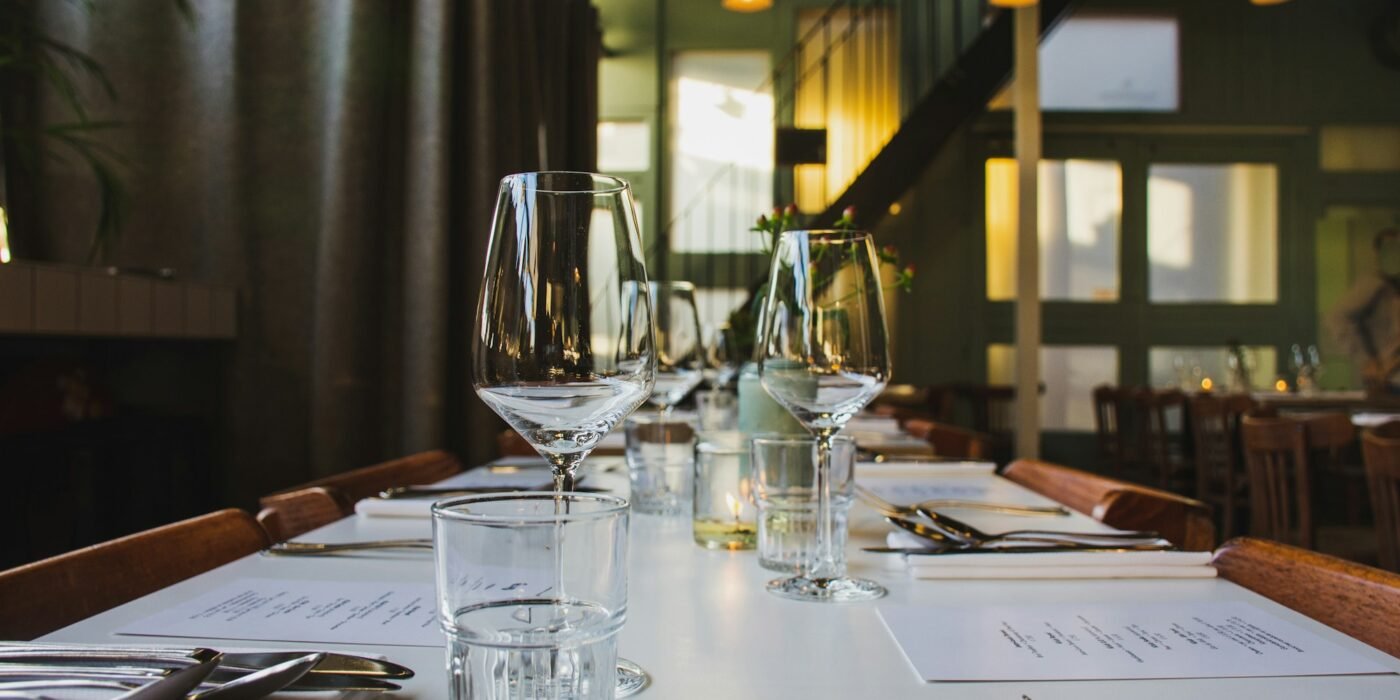
The famous question has a simple answer: work from the outside in. The cutlery is laid in the order you will need it, so the outermost pieces are for the first course. Dessert spoon and fork sit above the plate. Glasses are on your right, bread plate on your left.
Hold the fork in your left hand, tines down, and the knife in your right. Cut one or two pieces at a time rather than the whole plate at once. In the United States it is normal to cut, then switch the fork to the right hand to eat; both styles are correct where they are customary.
During the meal
- Wait for your host to start eating, or for everyone to be served, unless you are told to go ahead while it is hot.
- Bring the food to your mouth, not your head to the plate. Sit up straight, elbows off the table while you are eating.
- Small mouthfuls, mouth closed, and never talk with food in your mouth. A small bite means you are always ready to answer a question.
- Pass dishes in one direction, usually to the right, so nothing collides mid-table. Pass the salt and pepper together, even if only one was asked for. (Port is the famous exception: it goes to the left.)
- Ask, don’t reach. If something is beyond your arm’s length, ask the person nearest to pass it.
- Pace yourself to the table. Try not to finish long before or long after everyone else.
- Talk to both neighbours. At a formal dinner, the old custom is to speak to the person on one side during the first course and the other during the next. The principle matters more than the timing: nobody should be left talking to their plate.
The silent signals
Your cutlery tells the staff, and your host, whether you have finished. If you are pausing, rest the knife and fork apart on the plate, tips pointing towards the centre. When you have finished, place them together in the middle of the plate, handles towards you (roughly at six o’clock). Never put used cutlery back on the tablecloth.
Drinks and toasts
Hold a stemmed glass by the stem, so your hand doesn’t warm the wine. Let the host pour, or top up your neighbours’ glasses before your own. When a toast is proposed, raise your glass and make eye contact; you don’t need to clink every glass at a large table, and you should never drink a toast made to you.
Rules you can forget
- Elbows on the table between courses. Leaning in during conversation, when no one is eating, is fine.
- Waiting for the women to sit before the men. Helping everyone to their seats, whoever they are, is the modern version.
- Never mentioning money, work or politics. Sensible topics are welcome. What matters is reading the table and not dominating it.
- Panicking over a mistake. If you use the wrong fork or drop something, carry on calmly. Nobody remembers the mistake, only the fuss.
Nobody remembers the mistake, only the fuss.
At the end
Wait for the host to rise before you leave the table. Thank the host on the way out, and thank them again in writing within a day or two. If you are in a restaurant, thank the staff too; they will remember it.
Questions people ask
What do I do if I don’t like the food?
At someone’s home, eat a little of everything you can and leave the rest without comment. In a restaurant, if a dish is genuinely wrong, tell the staff quietly; if it is simply not to your taste, let it go.
Should I tell the host about allergies?
Yes, when you accept the invitation, not when you sit down. A host would far rather know in advance than discover it at the table.
Is it rude to leave food on my plate?
Not in Britain, where a little left over is perfectly normal. Customs differ elsewhere, so if you are abroad, watch what your host does.
Ordering in a restaurant? Read our guide to ordering wine without bluffing.
How we wrote this: these manners follow long-established British and European custom. Practices differ around the world, so when abroad, follow your host.