How a suit should fit: the twelve checks a tailor makes
Fit matters more than price. The twelve things a good tailor looks at, from the shoulders to the break, and which problems are worth fixing.
A suit that fits is worth three that don’t. Fit is what separates a man who looks at ease from one who looks dressed by someone else, and it has very little to do with price. An inexpensive suit, well fitted, will beat an expensive one hanging off the wrong shoulders every time.
These are the twelve things a good tailor looks at, in roughly the order they look. Learn them and you will know in two minutes in a changing room whether a suit is worth buying, and what it will need.
Before you start
Wear, or bring, the shirt and shoes you will wear with the suit. Empty your pockets. Stand naturally, not to attention; tailors are fitting the way you actually stand. And if there is no three-way mirror, ask someone to photograph you from the side and the back.
The jacket
1. Shoulders
The most important check, because it is the hardest to fix. The shoulder seam should end where your shoulder ends. Too wide and you will see a dent or a sag at the top of the sleeve; too narrow and the sleeve head pulls and ripples across the top of your arm. Lean against a wall: if the jacket’s shoulder touches it before your own shoulder does, it is too big.
2. Collar
The jacket collar should sit against your shirt collar all the way round, with no gap at the back of the neck. A little of the shirt collar, roughly a centimetre, should show above it. A collar that stands away from the neck is a common fault, and one only a skilled tailor can put right.
3. Chest and lapels
The lapels should lie flat against your chest when the jacket is buttoned. If they bow outwards, the chest is too tight; if the fabric collapses into folds, it is too loose.
4. Buttoning
Fasten the top button of a two-button jacket (never the bottom one). It should close without strain. If the fabric pulls into an X around the button, the jacket is too tight through the middle. If you can pull it several centimetres away from your stomach, it is too loose.
5. The back
Look in the mirror from behind. The back should be smooth. Horizontal folds just below the collar mean it is too tight across the shoulder blades or sitting wrongly on the neck; loose vertical folds mean there is too much fabric. Vents should hang closed and straight, not pulled open.
6. Waist
A good jacket follows the line of your body: a little shape at the waist, so it does not hang like a box. It should skim, not cling. This is one of the easier things to adjust, so a jacket that is slightly too full here is not a reason to walk away.
7. Jacket length
The jacket should cover your seat. A traditional check is to let your arms hang and curl your fingers: the hem should sit roughly where your fingers cup. Fashion has pushed jackets shorter, but a jacket that stops above the seat makes the legs look long and the body short. Length is very hard to alter, so get it right in the shop.
8. Armholes
Raise your arms as if hailing a taxi, then reach forward as if for a handshake. In a well-cut jacket with higher armholes, the whole jacket barely moves. If the collar lifts off your neck or the body rides up dramatically, the armholes are cut low, which is cheaper to make and less comfortable to wear.
9. Sleeve pitch
Let your arms hang naturally. The sleeves should fall cleanly, with no diagonal creases twisting around the upper arm. Everyone’s arms hang at a slightly different angle, and the way a sleeve is set into the shoulder (its pitch) needs to match yours.
10. Sleeve length
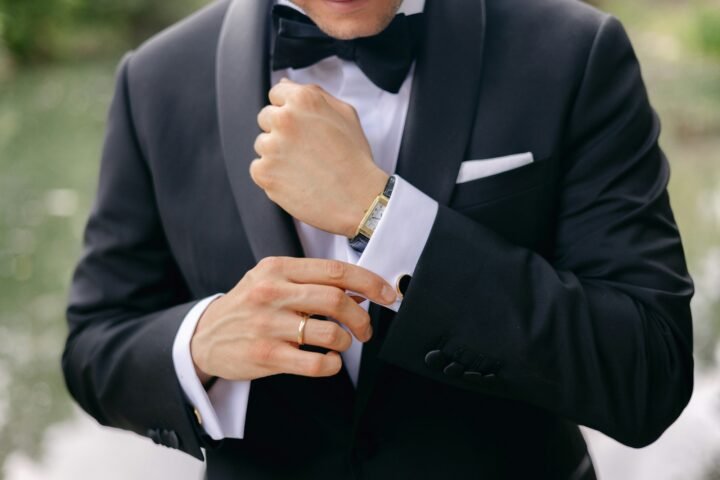
With your arms by your sides, about a centimetre of shirt cuff should show below the jacket sleeve. Sleeves are usually easy to shorten or lengthen, unless the cuff buttons are working buttonholes that already open, in which case changes are much harder. Check before you buy.
The trousers
11. Waist, rise and seat
Suit trousers should stay up without a belt doing the work. The rise, the distance from the crotch to the waistband, should be long enough to sit comfortably at your waist rather than on your hips. The seat should be smooth, without bagging or pulling; sit down in the changing room to check, and make sure nothing digs in or strains at the thigh.
12. Length and break
The “break” is the fold where the trouser meets the shoe. A slight break, a single soft fold, is the classic and safest choice. No break looks sharper and more modern, especially with a narrower leg; a full break looks dated. At the back, the hem should reach the top of the shoe heel. Hemming is the simplest alteration there is, so this should never stop you buying.
What a tailor can and can’t fix
| Easy to alter | Possible, with a good tailor | Walk away |
|---|---|---|
| Trouser length and hem | Jacket waist | Shoulders |
| Trouser waist (within the seam allowance) | Collar gap | Jacket length |
| Sleeve length (non-working buttons) | Sleeve pitch | Chest that is far too tight |
| Taper of the trouser leg | Seat of the trousers | Armholes cut too low |
The rule is simple: buy for the shoulders and the length, and let the tailor do the rest. A suit that fits there and needs a few easy changes elsewhere is a good buy. A suit that needs the shoulders reworked is not, whatever the discount.
Questions people ask
How tight should a suit be?
Close enough to follow your shape, loose enough to sit, reach and move without anything pulling. If you are aware of the suit when you move, it is too tight.
Should I buy a suit that is slightly too big or slightly too small?
Slightly too big, as long as the shoulders fit. Taking fabric in is easier than letting it out, and there may not be enough fabric in the seams to let a small suit out.
How much shirt cuff should show?
About a centimetre, with your arms relaxed by your sides. It frames the hands and protects the jacket sleeve from wear.
Once you know how a suit should fit, read our guide to the only five suits a man needs, and the order to buy them.
How we wrote this: these checks reflect long-established tailoring practice. Every body is different, so a good tailor’s eye on the day always beats a rule of thumb.